Have you ever wondered why some jokes make you laugh instantly while others make you think for a moment before the punchline clicks? The answer often comes down to the type of joke, the way it is delivered, and the kind of humor it uses.
Jokes can be short or long, clever or silly, clean or edgy, and sometimes even completely nonsensical. Understanding the differences between them can make it easier to recognize why certain jokes work so well.
What Is a Joke?
A joke is a form of humor designed to entertain, surprise, or make people laugh. Most traditional jokes have a setup that creates an expectation followed by a punchline that changes that expectation in an unexpected or funny way.
For example:
Why did the bicycle fall over?
Because it was two-tired!
The humor comes from the double meaning of “two-tired” and “too tired.”
What Is the Difference Between Different Types of Jokes?
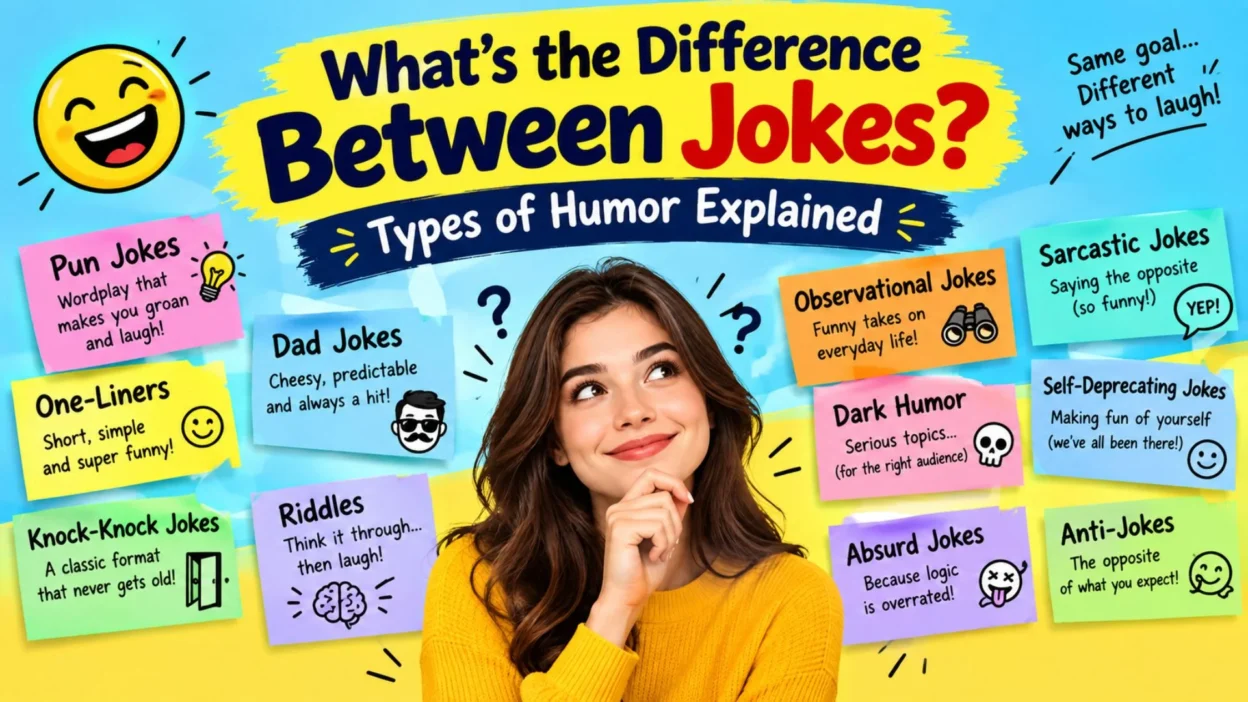
The main difference is how the humor is created. Some jokes depend on wordplay, while others use exaggeration, unexpected situations, sarcasm, or clever observations.
Here are some of the most common types.
1. Pun Jokes
Puns use words that have multiple meanings or sound similar to other words.
Example:
I used to be a baker, but I couldn’t make enough dough.
The word “dough” refers both to money and the mixture used for baking.
Why they’re funny:
Puns rely on language and unexpected connections between words.
2. One-Liner Jokes
A one-liner delivers the entire joke in a single sentence.
Example:
I told my suitcase there would be no vacations this year. Now I’m dealing with emotional baggage.
These jokes are short, quick, and easy to remember.
3. Knock-Knock Jokes
Knock-knock jokes follow a familiar question-and-answer format.
Example:
Knock, knock.
Who’s there?
Lettuc.
Lettuce who?
Letuce in—it’s cold out here!
The predictable structure makes them especially popular with children.
4. Dad Jokes
Dad jokes are usually simple, harmless jokes built around obvious puns or deliberately cheesy wordplay.
Example:
What do you call cheese that isn’t yours?
Nacho cheese!
The humor often comes from how predictable and corny the punchline is.
5. Observational Jokes
Observational humor focuses on ordinary experiences that people recognize from everyday life.
For example, a comedian might joke about how difficult it is to find your phone when it is already in your hand.
These jokes work because the audience recognizes the situation and thinks, “That’s so true!”
6. Sarcastic Jokes
Sarcasm involves saying something that means the opposite of the literal words, often for humorous effect.
For example, someone might look outside at heavy rain and say:
“Perfect weather for a picnic.”
The humor comes from the contrast between what is said and what is actually happening.
7. Dark Humor
Dark humor finds comedy in serious, uncomfortable, or taboo subjects. It can be highly dependent on context and audience.
Because people have different boundaries, dark joke can be inappropriate in some situations. Good judgment matters when using this type of humor.
8. Self-Deprecating Jokes
Self-deprecating humor makes the speaker the subject of the joke.
Example:
I’m great at multitasking. I can waste time, procrastinate, and forget what I was doing all at once.
This style can feel relatable because it focuses on everyday imperfections.
9. Absurd or Surreal Jokes
Absurd humor uses situations that make little or no logical sense.
Example:
I asked my cat for career advice. She told me to pursue something with more paws-ibilities.
The humor can come from combining unrelated ideas or creating ridiculous situations.
10. Anti-Jokes
An anti-joke intentionally avoids the expected funny punchline.
For example:
Why did the chicken cross the road?
To get to the other side.
The answer is completely ordinary, which is precisely what makes the joke amusing in context.
11. Riddles
Riddles are questions or puzzles that require the listener to figure out an answer.
Example:
What has keys but can’t open locks?
A piano.
Unlike a simple joke, a riddle often requires the audience to solve a small puzzle before reaching the punchline.
12. Story Jokes
Story joke use a longer setup before reaching the punchline. They may involve several characters, events, and twists.
The extra details build anticipation and make the final punchline more effective.
Jokes vs. Puns: What’s the Difference?
A joke is a broad category of humor, while a pun is a specific technique that can be used inside a joke.
In other words, every pun can be used as a joke, but not every joke is a pun.
For example:
Why did the math book look sad?
Because it had too many problems.
That’s a joke that uses wordplay, making it a pun-based joke.
Jokes vs. Humor: What’s the Difference?
The words “joke” and “humor” are related but aren’t exactly the same.
Humor is the broader concept of finding or creating amusement. A joke is a specific expression of humor.
A funny story, facial expression, cartoon, prank, pun, or observation can all involve humor without necessarily being a traditional joke.
Why Do Different Jokes Make Different People Laugh?
People have different experiences, personalities, cultures, and senses of humor. As a result, one person may love clever wordplay while another prefers silly joke or observational comedy.
Timing also matters. The same joke can receive completely different reactions depending on how and when it is delivered.
How to Choose the Right Type of Joke
The best type of joke depends on your audience and situation.
- For children: Try knock-knock jokes, simple riddles, and clean puns.
- For friends: Wordplay, observational humor, and silly jokes can work well.
- For social media: Short one-liners and relatable jokes are easy to share.
- For a professional setting: Keep humor light, respectful, and appropriate.
- For comedy writing: Experiment with setups, wordplay, exaggeration, and unexpected endings.
Final Thoughts
The difference between jokes usually comes down to how the humor is created and delivered. Puns play with words, one-liners rely on brevity, observational jokes focus on everyday experiences, riddles challenge the audience, and absurd jokes embrace the unexpected.
There isn’t just one formula for being funny. The variety of joke styles is what makes humor so interesting—and gives everyone a chance to find the type of comedy they enjoy most.

Logan Chase is a creative writer at Pickupzonee, known for crafting witty pickup lines, clever jokes, and playful puns.He helps turn everyday conversations into fun, memorable moments with the perfect choice of words.