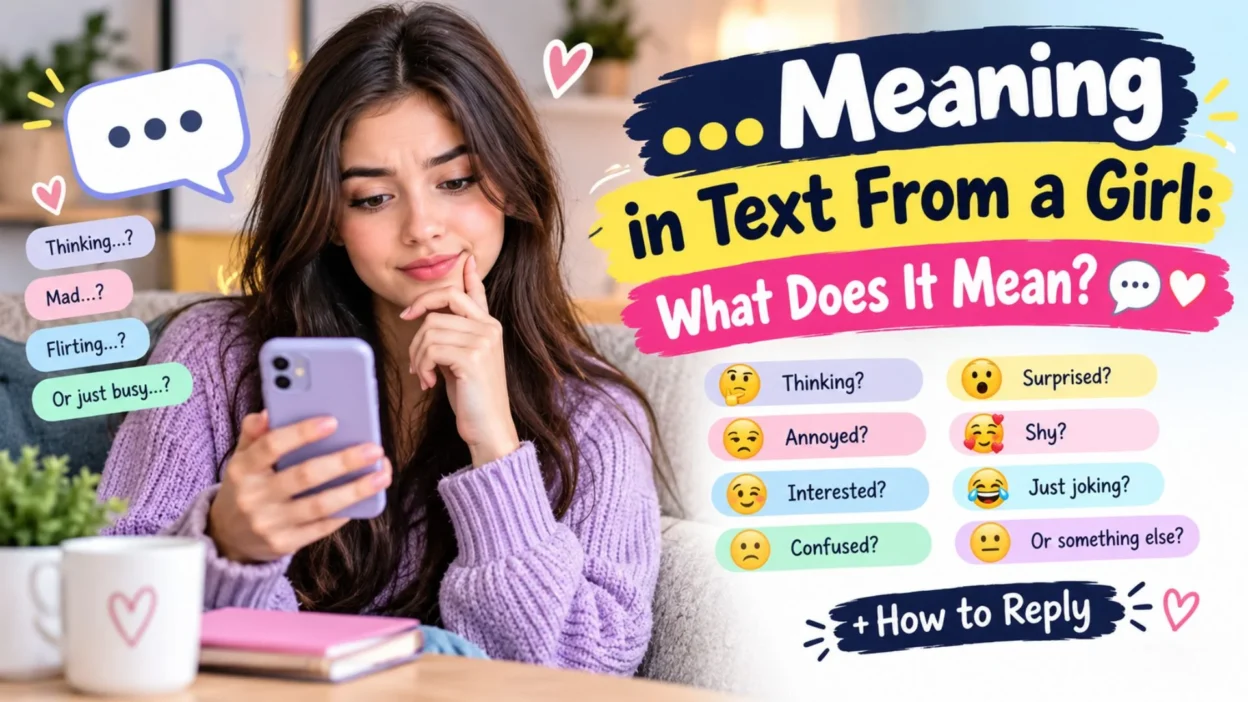
Seeing three dots in a text can make you wonder what someone really means. When a girl sends “…”, it may look like a tiny and harmless punctuation mark, but the meaning can change depending on the conversation, her texting style, and what happened before it. That is why people often search for … meaning in text from a girl when they are unsure whether she is confused, annoyed, interested, disappointed, or simply thinking about what to say.
The three dots are called an ellipsis. In texting, however, they can carry more emotion than they do in formal writing. For example, “okay” feels different from “okay…”, while “really?” feels different from “really…”.
In this guide, you will learn the most common meanings of “…” from a girl, what it can mean in different situations, how to tell whether she is upset or interested, and what you can say in response. The goal is simple: help you understand the context without overthinking every little dot.
💬 What Does “…” Mean in Text From a Girl?
When a girl sends “…”, there is no single universal meaning. The three dots usually suggest that something is being left unsaid, delayed, or implied.
Here are some common possibilities:
- 💭 She may be thinking about what to say next.
- 😶 She may not know how to respond to your message.
- 😒 She could be slightly annoyed by something you said.
- 👀 She may be waiting for you to explain yourself.
- 😳 She could be surprised by your message.
- 🤔 She may find your message confusing or unexpected.
- 😂 She might be jokingly reacting to something ridiculous.
- ❤️ She could be interested but unsure how to respond.
- 🙃 She may feel awkward about the conversation.
- 😬 She might think your message was questionable.
- 🫢 She could be holding back something she wants to say.
- ⏳ She may simply be taking time before answering.
- 😑 She could be showing mild disappointment.
- 🧐 She may want you to continue explaining.
- 💬 She might expect you to understand the implied meaning.
The context matters more than the dots themselves. If she normally uses “…” with everyone, it may simply be her texting style. If she suddenly starts using it after a serious message, however, it may carry more emotional weight.
😏 Does “…” Mean She Is Interested?
Sometimes, but not automatically. A girl using “…” does not prove that she likes you or is flirting with you.
If the conversation is already playful or romantic, the dots can create suspense. She might be teasing you, waiting for you to say more, or deliberately leaving a thought unfinished.
For example, if you say, “I have something to tell you…” and she replies, “What…?”, the dots may simply add curiosity.
Look at the whole conversation instead of focusing on punctuation alone:
- ❤️ She regularly starts conversations with you.
- 📱 She replies quickly and keeps conversations going.
- 😏 She uses playful or teasing messages.
- 👀 She asks personal questions about you.
- 😂 She frequently jokes and laughs with you.
- 💬 She finds reasons to continue talking.
- 🥰 She uses affectionate emojis or nicknames.
- 🔥 She responds positively to light flirting.
- 😊 She remembers small details you previously mentioned.
- 👋 She often messages you without needing a reason.
- 💭 She asks follow-up questions instead of ending chats.
- 😌 She seems comfortable sharing personal thoughts.
- 🎯 She responds directly to things you say.
- 🫶 She shows consistent interest rather than occasional attention.
- ✨ Her overall communication feels warm and engaged.
Still, none of these signs individually proves romantic interest. Consistency and context are much more useful than one punctuation mark.
😒 Does “…” Mean She Is Mad?
It can. In some conversations, “…” can signal irritation, disappointment, or frustration.
For example, imagine you tell her, “I completely forgot about our plans.”
She replies:
“Okay…”
That may sound very different from a simple “Okay.” The dots could suggest that she is disappointed or expects you to realize that something went wrong.
Possible signs that the dots indicate annoyance include:
- 😒 She becomes noticeably shorter in her replies.
- ❄️ Her normally warm messages suddenly feel cold.
- ⏳ She takes much longer to respond than usual.
- 😑 She replies with “okay…” after something disappointing.
- 🙄 She uses sarcastic wording around the dots.
- 💬 She stops asking questions.
- 📱 She no longer keeps the conversation moving.
- 😶 She gives unusually brief answers.
- 🫤 She mentions something that bothered her.
- 🚫 She avoids discussing the issue directly.
- 😬 The message follows an argument or misunderstanding.
- 👀 She seems to be waiting for an apology.
- 💭 She says something feels “fine” when it clearly does not.
- 😕 Her tone changes immediately after your message.
- 🧊 The conversation suddenly feels distant.
If several of these happen together, the dots may be signaling frustration rather than flirting.
🤔 What Does “Okay…” Mean From a Girl?
“Okay…” is one of the most context-dependent messages you can receive.
A simple “Okay” can sound neutral. Adding three dots can make it feel hesitant, disappointed, suspicious, sarcastic, or emotionally unfinished.
For example:
You: “I can’t come tonight.”
Her: “Okay…”
She may be disappointed.
But consider another situation:
You: “I have a surprise for you.”
Her: “Okay… 👀”
Now the message could be playful or curious.
The possible meanings include:
- 😕 “I’m disappointed.”
- 🤔 “I’m not sure about that.”
- 😒 “I don’t really like what you said.”
- 👀 “I’m waiting for you to explain.”
- 😏 “Interesting… tell me more.”
- 😂 “You’re being ridiculous.”
- 😶 “I don’t know what to say.”
- 💭 “I’m thinking about it.”
- 🙃 “That was awkward.”
- ❤️ “I’m shy about this conversation.”
- 🫢 “You caught me off guard.”
- 😬 “I’m uncomfortable with that.”
- ⏳ “Give me a moment.”
- 🧐 “Something about this doesn’t add up.”
- 💬 “There is more I want to say.”
So, never assume that “okay…” automatically means she is angry.
👀 What Does “…” Mean When She Likes You?
If a girl likes you, she may use “…” as a playful way to create suspense or show that she is shy.
For example:
You: “I think you look really cute today.”
Her: “Oh… really? 😊”
Here, the dots could suggest surprise or shyness.
Another example:
You: “Guess who I’ve been thinking about?”
Her: “Who…?”
The dots create anticipation and invite you to continue.
Possible romantic meanings include:
- 😳 She feels shy about your compliment.
- ❤️ She is interested but does not want to say it directly.
- 😏 She is teasing you.
- 👀 She wants you to continue flirting.
- 🫢 She is surprised by your confidence.
- 😊 She is enjoying the attention.
- 💭 She is choosing her words carefully.
- 🔥 She wants to make the conversation more playful.
- 🥰 She feels slightly embarrassed in a good way.
- 😉 She is hinting without saying everything.
- 💬 She wants you to ask what she means.
- ✨ She is creating a little suspense.
- 😌 She feels comfortable being playful with you.
- 🫶 She is responding emotionally rather than formally.
- 👀 She wants to see where the conversation goes.
However, attraction cannot be determined from “…” alone. Her overall behavior is much more meaningful.
😶 What Does “…” Mean When She Is Confused?
Sometimes three dots simply mean that a girl does not know what to say.
Maybe your message was unexpected, complicated, awkward, or completely random. Instead of writing a full response, she may use “…” to show that she is processing it.
For example:
You: “I accidentally sent your mom a meme.”
Her: “…”
That probably does not mean she is flirting.
It could mean:
- 😳 She is shocked.
- 😂 She cannot believe what happened.
- 🤔 She is processing the situation.
- 😶 She does not know how to respond.
- 🫢 She is speechless.
- 🙃 She finds the situation awkward.
- 😬 She thinks you made a mistake.
- 👀 She wants more details.
- 💭 She is deciding what to say.
- 😂 She is trying not to laugh.
- 😑 She thinks you are being ridiculous.
- 🧐 She needs clarification.
- ⏳ She wants a moment.
- 💬 She expects you to explain.
- 😅 She is unsure how seriously to take you.
In these situations, asking a simple follow-up question is usually better than guessing.
😳 What Does “…” Mean After a Compliment?
A girl may respond with “…” after a compliment because she feels shy, surprised, embarrassed, or unsure how to respond.
Imagine saying:
“You looked amazing today.”
She replies:
“…”
That does not automatically mean she disliked the compliment.
She might be:
- 😳 Feeling shy.
- 😊 Trying to think of a response.
- 🥰 Secretly enjoying the compliment.
- 🫢 Surprised that you noticed.
- 😅 Feeling awkward about receiving praise.
- ❤️ Unsure whether you were flirting.
- 🤔 Wondering how seriously you meant it.
- 👀 Waiting to see what you say next.
- 😏 Teasing you.
- 💭 Choosing a careful response.
- 🙈 Feeling embarrassed.
- 😂 Not knowing how to react.
- 😌 Taking the compliment in.
- ✨ Enjoying the attention.
- 💬 Hoping you will continue the conversation.
If she follows the dots with something positive like “that’s sweet” or a smiling emoji, the response is probably warmer than it first appears.
😂 What Does “…” Mean in a Funny Conversation?
Not every “…” is serious. In a funny conversation, three dots can actually make a joke funnier.
Suppose you send:
“I could probably survive one week without coffee.”
She responds:
“…”
That could be a playful way of saying, “I absolutely do not believe you.”
The meaning may be:
- 😂 “Seriously?”
- 😭 “I cannot believe you.”
- 🙄 “Here you go again.”
- 😏 “Sure you could.”
- 🤨 “Are you being serious?”
- 🤣 “That was ridiculous.”
- 😑 “I’m judging you.”
- 👀 “Interesting claim.”
- 🫢 “You really said that?”
- 😅 “I don’t know how to respond.”
- 🤔 “Explain yourself.”
- 💀 “I’m speechless.”
- 😂 “You are impossible.”
- 😆 “That was unexpectedly funny.”
- 🙃 “I am choosing not to comment.”
In a playful chat, the dots can function almost like a dramatic pause.
💔 What Does “…” Mean After an Argument?
After an argument, “…” usually deserves more attention.
A girl might use the dots because she is upset but does not want to explain everything immediately. She may also be tired of arguing or waiting for you to understand what went wrong.
For example:
You: “I didn’t think it was a big deal.”
Her: “…”
That response could communicate disappointment without directly saying it.
After an argument, “…” may mean:
- 😒 “I cannot believe you said that.”
- 😑 “I don’t know what else to say.”
- 💔 “You hurt my feelings.”
- 😶 “I’m too upset to respond.”
- 🙄 “You are not understanding.”
- 🫤 “This conversation is frustrating.”
- ⏳ “I need some time.”
- 💭 “I’m thinking about what you said.”
- 🧊 “I am becoming distant.”
- 😕 “I don’t understand your reasoning.”
- 🚫 “I don’t want to continue this argument.”
- 👀 “You should know what happened.”
- 😔 “I’m disappointed.”
- 💬 “There is more I want to discuss.”
- 🫶 “I still care, but I’m upset.”
In this situation, responding defensively can make things worse. A calm message is usually more helpful.
💕 What Does “…” Mean in a Flirty Text?
In a flirty conversation, “…” can create suspense. It can make a message feel teasing, mysterious, or slightly suggestive without directly saying anything.
For example:
You: “You know exactly what you’re doing…”
Her: “Maybe… 😏”
Here, the dots are part of the playful tone.
In flirting, “…” may suggest:
- 😏 She is teasing you.
- 👀 She wants you to continue.
- 😉 She is being playful.
- ❤️ She is feeling shy.
- 🔥 She wants to build suspense.
- 🫢 She is hinting at something.
- 😳 She feels embarrassed.
- 💭 She is choosing her words carefully.
- 😂 She is joking around.
- ✨ She wants the conversation to stay interesting.
- 🥰 She enjoys the attention.
- 😌 She feels comfortable flirting.
- 💬 She expects another message.
- 👀 She is curious about your reaction.
- 😉 She is leaving the answer open-ended.
Still, read the entire conversation. Flirting usually appears through a pattern of playful behavior, not one punctuation mark.
📱 “…” vs “Okay” vs “Okay…” — What Is the Difference?
Small changes in texting can affect how a message feels.
Consider these three replies:
“Okay.”
This can sound direct, neutral, or final.
“Okay”
This often feels casual and relaxed.
“Okay…”
This can feel hesitant, disappointed, suspicious, playful, or unfinished.
The exact tone depends on the situation.
For example:
You: “I forgot to bring the snacks.”
Her: “Okay.”
This may simply be acceptance.
Her: “Okay…”
This might suggest disappointment or a silent expectation that you fix the problem.
But if the conversation is playful:
You: “I’m definitely not eating the last slice.”
Her: “Okay…”
Now she might be teasing you because she knows you probably will.
That is why punctuation should always be interpreted alongside the words and situation.
🧐 How to Know What “…” Really Means
If you want to understand the message correctly, look at the context instead of guessing from the punctuation.
A few clues can help:
- 💬 Read the message immediately before the dots.
- ❤️ Consider your relationship with her.
- 📱 Compare her usual texting style.
- 😒 Notice whether her tone recently changed.
- ⏰ Consider how quickly she normally replies.
- 👀 Look at whether she continues the conversation.
- 😂 Check whether the chat was already humorous.
- 💕 Notice whether flirting was happening beforehand.
- 🧠 Think about whether your message needed an explanation.
- 😳 Consider whether you surprised her.
- 💭 Ask whether the topic was emotionally serious.
- 🫤 Look for signs of disappointment.
- 😊 Check whether she uses friendly emojis afterward.
- 🧊 Notice whether her messages have become colder.
- 💬 If unsure, simply ask what she means.
The last option is often the easiest. You do not need to become a detective over three dots.
💬 How Should You Reply When a Girl Sends “…”?
Your response should depend on the situation. she seems confused, clarify. If she seems upset, acknowledge it. If she is flirting, you can play along.
Here are some simple replies:
- 😊 “Haha, what does that mean?”
- 👀 “Those three dots look suspicious.”
- 😂 “Okay… should I be worried?”
- 🤔 “What are you thinking?”
- 😅 “I feel like there’s more you want to say.”
- 👀 “Go on, I’m listening.”
- 😂 “That pause said a lot.”
- 😏 “Was that a dramatic pause?”
- 💬 “Did I say something wrong?”
- 🫢 “You seem speechless.”
- ❤️ “Take your time. I’m listening.”
- 😌 “You can tell me what you’re thinking.”
- 🤔 “Should I explain?”
- 😂 “I know that ‘…’ means something.”
- 💬 “What’s going through your mind?”
If you think she is genuinely upset, avoid making jokes immediately. A simple “Did I upset you?” may be much better.
🚩 When “…” May Be a Bad Sign
Although three dots are not automatically negative, there are situations where they can signal that the conversation is not going well.
Pay attention when “…” appears alongside a sudden change in behavior.
Possible warning signs include:
- 🧊 Her messages become consistently cold.
- 😒 She stops responding with her usual energy.
- 🚫 She avoids questions you normally discuss.
- 😑 She repeatedly responds with very short messages.
- 💔 The dots appear after something hurtful happened.
- ⏳ She repeatedly leaves conversations unfinished.
- 🙄 Her messages become noticeably sarcastic.
- 🫤 She says she is fine but sounds upset.
- 💬 She mentions being disappointed with you.
- 📵 She stops initiating conversations.
- 🧊 She seems emotionally distant.
- 😕 She avoids explaining what bothers her.
- 🚫 She directly asks for space.
- 😔 She seems unhappy after your messages.
- 💭 The conversation feels tense rather than playful.
One message is not enough to reach a conclusion. Look for a consistent pattern before assuming something is wrong.
✨ Other Meanings of “…” in Texting
The ellipsis can communicate several emotions beyond flirting or annoyance. Sometimes, it simply changes the rhythm of a sentence.
Depending on context, “…” can mean:
- 💭 “I’m thinking.”
- 😶 “I don’t know what to say.”
- 👀 “I’m waiting.”
- 🤔 “I’m unsure.”
- 😳 “I’m surprised.”
- 😏 “I’m teasing.”
- 😂 “That is ridiculous.”
- 😒 “I’m annoyed.”
- 😔 “I’m disappointed.”
- 🫢 “I cannot believe that.”
- 😬 “This is awkward.”
- ❤️ “I’m feeling shy.”
- ⏳ “Give me a moment.”
- 🧐 “Explain that.”
- 💬 “Continue talking.”
The ellipsis is useful because it leaves space for interpretation. That is also why it can sometimes create confusion.
FAQ Section
What does “…” mean in text from a girl?
“…” can mean many things, including hesitation, confusion, surprise, annoyance, curiosity, shyness, or playful teasing. The correct meaning depends on the conversation and her normal texting style.
Does “…” mean she likes me?
Not necessarily. A girl can use “…” when she likes you, especially during a playful or flirty conversation, but the punctuation alone does not prove romantic interest.
Does “okay…” mean she is mad?
It can indicate disappointment or annoyance, especially after an argument or when something goes wrong. However, it can also mean hesitation, confusion, or playful teasing.
What should I reply when a girl sends “…” ?
A simple response such as “What are you thinking?” or “Those three dots look suspicious 😂” can keep the conversation going. If she seems upset, ask calmly whether something is wrong.
What does “…” mean after a compliment?
It may mean she feels shy, surprised, embarrassed, or unsure how to respond. Look at what she says afterward and whether her overall tone remains positive.
Is “…” a bad sign when texting?
Not always. Three dots are neutral by themselves. They become more concerning when they appear with cold replies, arguments, disappointment, or a noticeable change in her usual communication.
Conclusion
Understanding … meaning in text from a girl is less about the three dots and more about the situation surrounding them. The same “…” can mean “I’m thinking,” “I’m annoyed,” “I’m surprised,” “Tell me more,” or even “I’m teasing you,” depending on the conversation.
If the chat is playful, the dots may create suspense or flirting. you just had an argument, they may signal disappointment. If you sent something surprising, she may simply be trying to figure out how to respond.
Most importantly, do not overthink one punctuation mark. Look at her words, response time, usual texting habits, and overall behavior. When the meaning still is not clear, asking a simple question is usually better than guessing.
So, the next time you receive “…”, stay calm and read the context. And if you have your own interpretation or experience, share your favorite idea in the comments below!

Logan Chase is a creative writer at Pickupzonee, known for crafting witty pickup lines, clever jokes, and playful puns.He helps turn everyday conversations into fun, memorable moments with the perfect choice of words.